

A paper bowl looks like a cup with the top cut off, and buyers often source it that way - until the lids do not seat, the seams wick soup, or the freight per litre beats a competitor's quote. Four numbers decide whether a paper bowl works: brim volume, board weight, nesting, and rim diameter. None of them appears on a price list.
Volume Is Measured at the Brim, Not at the Fill Line
Our 150 mm salad bowl family is listed at 500, 750 and 1000 ml, each with a 150 mm top, a 130 mm base and a 45, 60 or 75 mm wall. Those are geometric capacity: filled level to the rim. Serving 400 ml into a 500 ml bowl is not wasteful - the rim has to stay clear for the lid, and a tilted bowl needs headspace. So ask what the actual portion is, and how far below the rim staff will fill it. If you sell by weight, convert once: a 350 g soup portion
is not 350 ml, and the density gap can move you up a size.
Board Weight and Coating Decide Whether a Paper Bowl Holds Soup
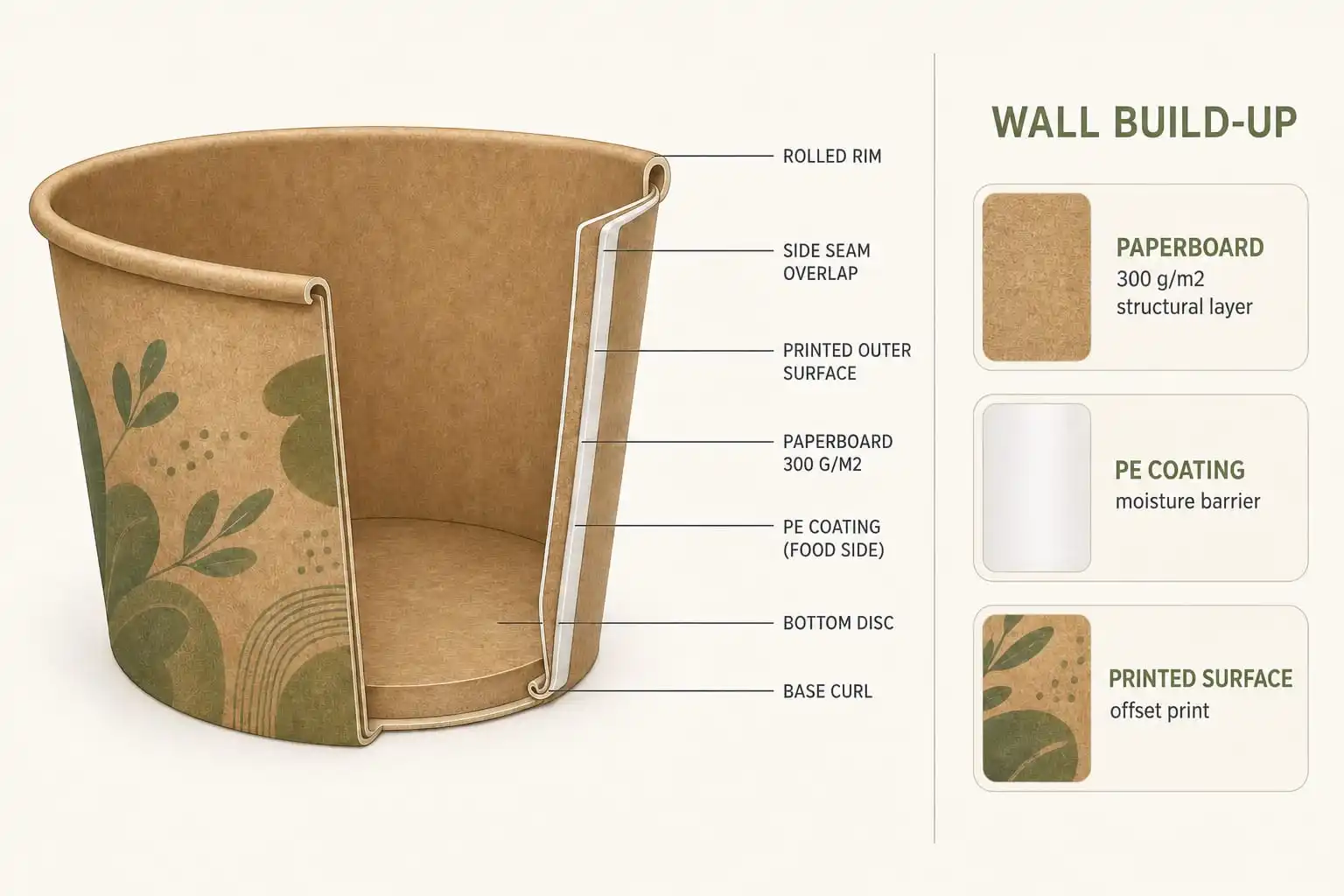
That same family is made from 320 g sunshine paper with a PE coating; neighbouring families run from 280 to 320 g. The soup bowl series is built on 300 g kraft board with an 18 g/m² PE coating - board and coating quoted separately, because they do different jobs. Board weight is quoted per square metre, so "320 g" describes the grade, not the stiffness of the finished bowl; rigidity comes from the grade, the coating weight, the blank area and the rolled rim together. A sheet that feels stiff in the hand can still go soft under a hot fill.
The coating is where hot soup is won or lost. PE is the standard moisture barrier and the safer choice for fills close to boiling; 18 g/m² is a film weight chosen for seam integrity, not a temperature rating. PLA is plant-based and chosen when compostability matters, but it softens at a lower temperature than PE and needs industrial composting, so it is not a drop-in swap on a 95 °C soup line. Our listing material quotes a service range up to 90 °C for PE-lined bowls; treat that as a working limit, not a tested rating, because no migration test at that temperature sits behind it.
Nesting Is Where the Paper Bowl Freight Bill Is Decided
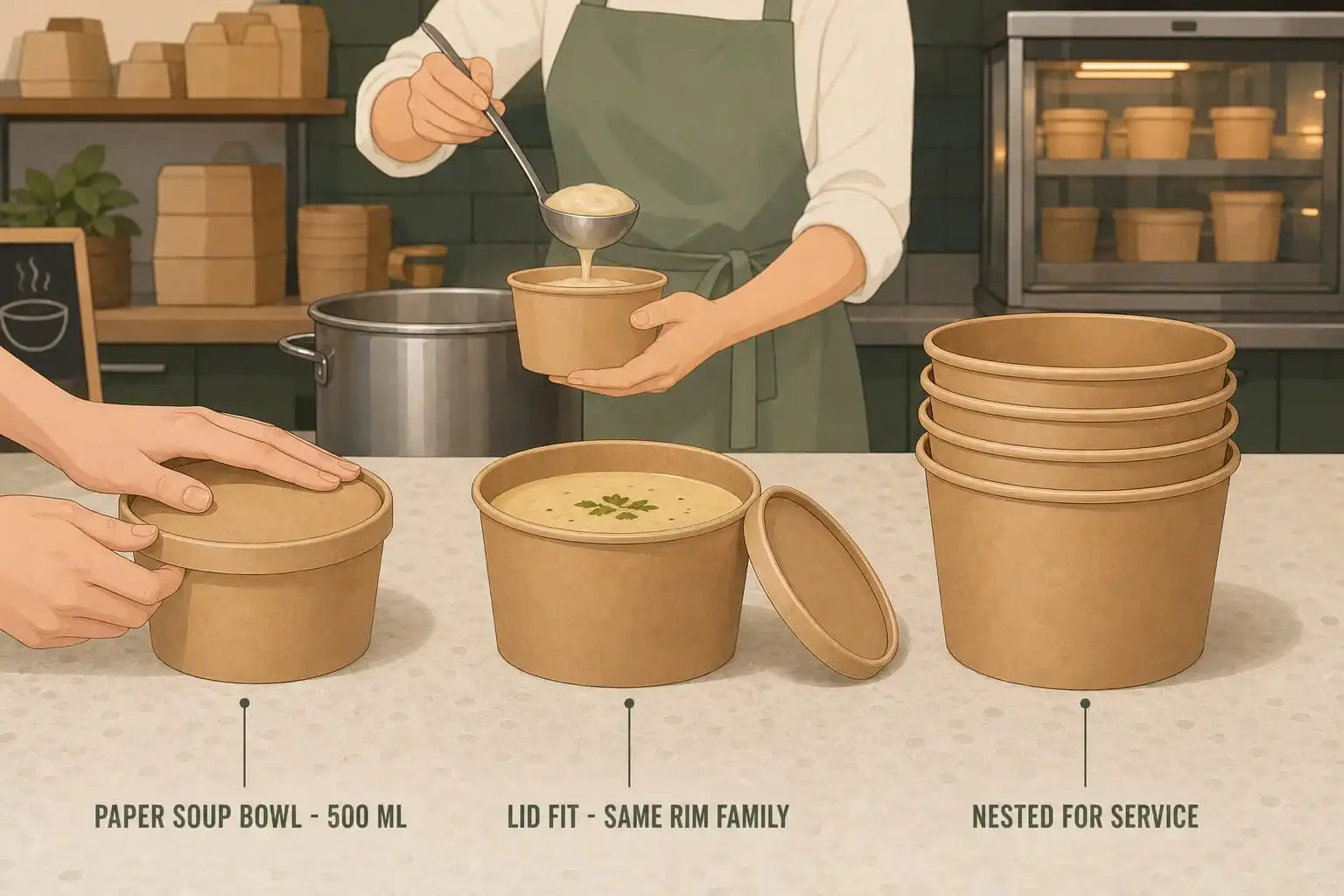
All three sizes are packed 50 pieces per pack, six packs per carton, 300 pieces per carton. The cartons measure 455 × 305 × 485 mm, 455 × 315 × 490 mm and 460 × 305 × 520 mm - 0.067, 0.070 and 0.073 m³. The 1000 ml carton is only about 8.5% larger than the 500 ml carton, yet it carries twice the litres. Per litre shipped, the larger bowl takes roughly half the carton volume. That is the argument against downsizing to save paper: below 500 ml a carton is mostly air, and you pay freight on it.
Rim Diameter Decides the Lid, and the Lid Decides the Menu
A bowl is only as good as its lid, and lids grip the rim's outside, so diameter - not volume - sets compatibility. Our soup bowl series runs from 6 oz to 32 oz across two rim families, roughly 99 mm and 115 mm; the 150 mm family needs a lid matched to its own rim. Even inside one nominal diameter, suppliers' rims differ within tolerance, so a lid that clicks onto our bowl may sit loose on yours. If soup is on the menu, buy bowl and lid from the same tooling and test the pair.
What a Bowl Test Report Should Cover
The dossier has two halves: the board (FDA 21 CFR 176.170 and 176.180 in the US; Regulation (EC) No 1935/2004 in the EU) and the coating (21 CFR 177.1520; Regulation (EU) No 10/2011 with amendments). One report on one half proves nothing about the other, or about a different size or print run.
Our SGS reports show how narrow that is. SHAHG2123705201 (10 November 2021) tests a PET cup lid, XYA 102, against Regulation (EU) No 10/2011 and amendment (EU) 2020/1245 - overall migration in 3% acetic acid and 50% ethanol at 70 °C for two hours. CANHL23006748201 (28 July 2023) tests PET cups, dome lids, PP cups, lids and straws against 21 CFR 177.1520 and 177.1630. Neither covers a paper bowl, and we hold no test of a board-and-film laminate at soup temperature.
So write the test into your purchase order: overall and specific migration on the finished bowl, at your fill temperature, in the simulant matching your soup, with a declaration of compliance that references it.
How Directive (EU) 2019/904 Treats a Coated Paper Bowl
A PE-coated bowl is made partly from plastic, and under Directive (EU) 2019/904 bio-based and biodegradable plastics are managed as plastics. Whether a given bowl counts as a single-use plastic product, and which duty follows - consumption reduction, marking or producer responsibility - depends on construction, market and use. We do not label our bowls as in or out of scope for your market; the final classification is the buyer's call.
Send Us a Portion, Not a Volume
Tell us the food, portion weight, fill temperature, lid and market, and we will match a bowl to that brief.
https://www.ipackpartner.com/contact-us