

The short answer
Start at the end of the cup's life, not at the price per thousand. For the EU and the UK, a water-based (aqueous) coating is the safest default: the dispersion releases fibre during repulping instead of surviving as a plastic film, and advanced aqueous board now carries third-party repulpability, PFAS and home-composting test reports. Choose PE when cost and a long-proven barrier decide the order. Choose PLA only where industrial composting collection exists, because EU rules classify PLA as plastic.
What Is a Paper Cup Lining, and Why Does the Choice Matter in 2027?
A paper cup is a fibre shell plus a thin barrier that stops liquid soaking into the board. Three chemistries dominate:
- PE (polyethylene) - extruded onto the board as a film; the established global standard.
- PLA (polylactic acid) - a bio-based polyester, also applied as a film, and industrially compostable.
- Water-based (aqueous) coating - a dispersion cured onto the fibre surface rather than laminated on top of it.
How Do PE, PLA and Water-Based Coatings Compare?
| Criterion | PE coating | PLA coating | Water-based coating |
|---|---|---|---|
| Water and grease barrier | High; very well established | High; broadly comparable to PE | Good when coat weight and curing are correct; formulation-dependent |
| Heat resistance | Strong; the default for hot beverages | Lower than PE - verify the maximum service temperature | Varies by formulation; test hot and oily fills |
| Recyclability in paper stream | Poor: the film must be separated from the fibre and is normally screened out | Structurally the same problem - a plastic film layer | Disperses and releases fibre during repulping; independently testable |
| Compostability | Not compostable | Industrially compostable (EN 13432-type certification) | May carry industrial and home-composting certification |
| EU regulatory treatment | Counts as a plastic-containing single-use item: marking and EPR apply | Also treated as plastic; bio-based status does not exempt it | No plastic film layer; confirm the dispersion's chemistry |
| Relative cost | Lowest and most widely available | Higher than PE | Higher than PE today |
Which Lining Should You Choose for Hot Coffee, Cold Drinks or Takeaway?
- Hot coffee and tea. PE is the most predictable; moving off PE means validating the water-based grade at your real fill temperature.
- Cold drinks. Water-based coatings handle cold and ambient fills well and give the strongest recyclability story.
- Oily takeaway. Barrier demand rises sharply - ask for a grade tested against the specific food.
- A composting-led promise. PLA for industrial routes; a certified aqueous grade for a home-composting claim.
What Do EU Rules Actually Require?
- Regulation (EU) 2025/40 (PPWR) entered into force on 11 February 2025 and applies from 12 August 2026. It aims to make all packaging on the EU market recyclable in an economically viable way by 2030, and restricts PFAS in food-contact packaging above certain thresholds.
- Directive (EU) 2019/904 (Single-Use Plastics) does not exempt bio-based or compostable plastics. Per European Bioplastics' reading of the Commission's guidance, paper plates with a plastic coating fall inside the banned categories, and beverage cups with a plastic layer face consumption-reduction, marking and EPR obligations.
How Do You Verify a Lining Claim Before You Order?
Ask for documents, not adjectives, and fix performance at sampling. A credible water-based "plastic free" file looks like this:
- Repulpability. An independent evaluation against a recognised standard. The plastic-free coated board IPACK uses across its water-based cup range scored 81/100 - "good recyclability" against T/CPA 001-2021 in a Sinolight evaluation (report № 2023070783).
- PFAS. A multi-substance screen on the coated paper, not a blanket statement. The same board reports PFOA and PFOS below 1 ng/g and total PFAS below 0.008 mg/kg across 176 substances (report 0724012917-EN, 2025).
- Non-plastic screening. A test that names the polymers excluded - PE, PP, PS, EVA, PET, PVA, PA, PVC - and the method used.
- Compostability. Name the standard and the route. Home composting (NF T51-800, AS 5810) is a different test from industrial (EN 13432, AS 4736) - and certificates expire, so check dates.
- Food contact. GB 4806.8-2022 for China, Regulation (EU) 1935/2004 with the EDQM guide for Europe, and an FDA food facility registration for the US.
FAQ
Can an aqueous-coated cup be home compostable?
Yes. IPACK's water-based coated cups use board holding DIN CERTCO home-composting certification 9P0166 to NF T51-800:2015, valid until 31 May 2029.
Is a PLA coating compostable at home?
No. PLA is engineered for industrial conditions and normally certified to EN 13432 - 90% disintegration within 12 weeks, 90% biodegradation within six months. Without industrial collection it behaves like any other plastic film.
Are PE-coated paper cups banned in the EU?
No - but consumption-reduction measures, plastic-content marking and EPR fees apply, and some Member States go further.
About IPACK
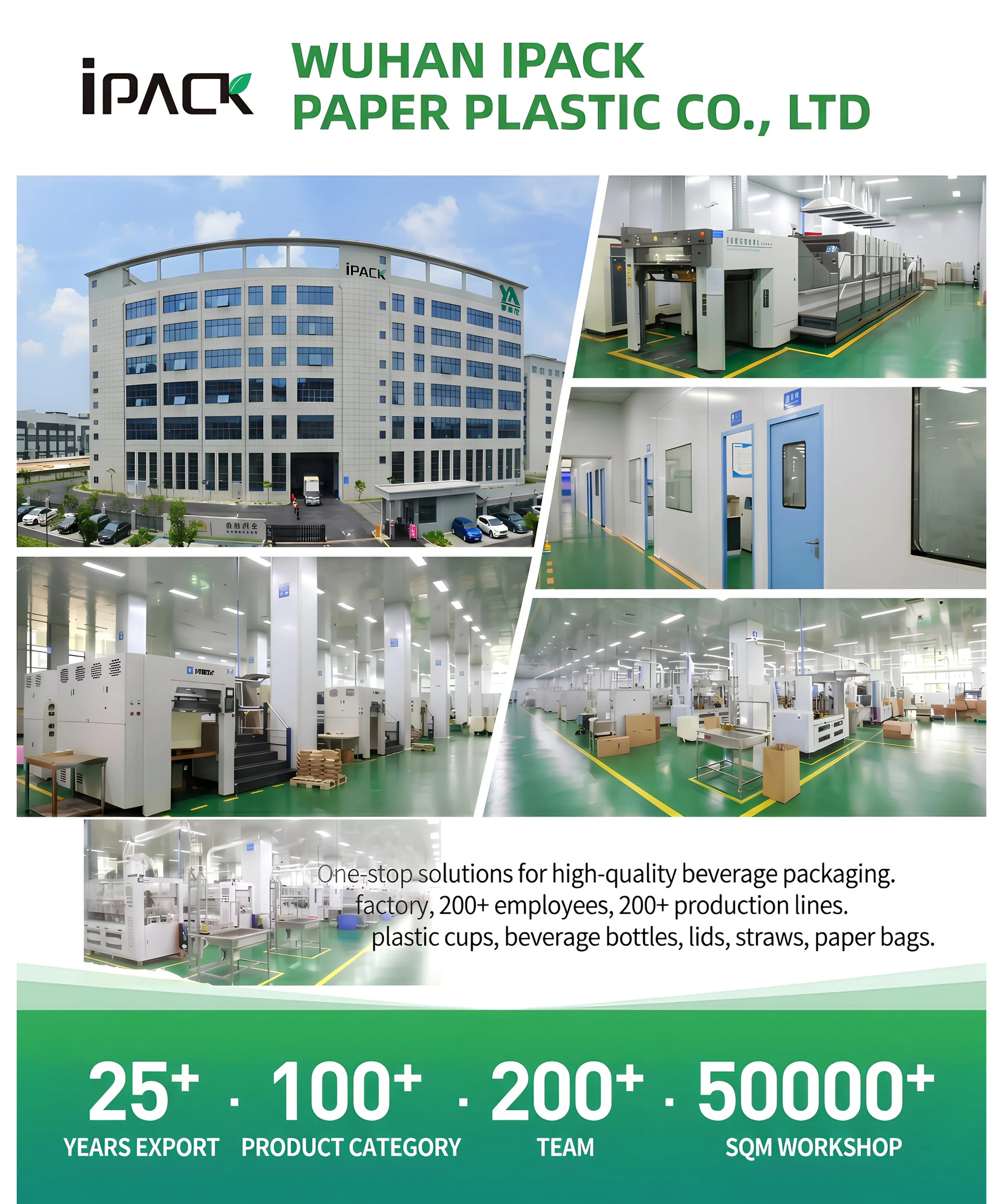
IPACK (Wuhan XinYong'an Paper Plastic Co., Ltd.) manufactures beverage and food packaging - paper cups and bowls, PET and PP cups, bottles, straws, paper bags and napkins - for buyers in the Middle East, Europe and North America. Its certificates include BRCGS Packaging Materials Issue 7, Grade A (NSF, valid to 16 September 2027), an amfori BSCI social audit (valid to 15 November 2026), ISO 9001:2015 and ISO 14001:2015 (CQC, valid to 5 February 2027), an International Halal Certificate (valid to 14 September 2028), and U.S. FDA Food Facility Registration No. 15904985240 (valid to 31 December 2026). IPACK will exhibit at Gulf Print & Pack 2027 in Dubai (12–14 January 2027, Hall 7, Dubai World Trade Centre).