

Two samples arrive in the same shade of brown fibre and both are called a bagasse food container. One is moulded pulp, pressed from a water slurry of sugarcane bagasse. The other is a paper-board tray with a plastic film on the inside. They look related. They fail in completely different ways.
What a Bagasse Food Container Really Is
Bagasse is the fibrous residue left after sugarcane is crushed for sugar. In moulded fibre production it is mixed with water, formed on a mesh tool, dried and pressed, which gives a thick, matte, rigid shell with a visible fibre surface. The natural kraft-brown tone is the standard finish; black and red dyed versions are used on premium and themed menus.
Our own moulded fibre tableware range covers that ground: a three-compartment tray, a two-compartment round-corner box, a shallow rectangular tray, an octagonal shallow bowl, a deep square bowl with rounded corners, a deep rectangular bucket and a long flat box. Dimensions, wall thickness, working volumes and carton data are [to be confirmed].
A paper-board tray is a different material. Sheet board is cut, creased and coated, so it brings print quality and a thin, even wall. Moulded fibre brings rigidity without a plastic film, a shape that holds sauce, and a thicker wall that insulates a hot portion. Neither is better. They solve different problems.
The Three Numbers That Decide Whether It Works
Most complaints trace back to measurements, not to material.
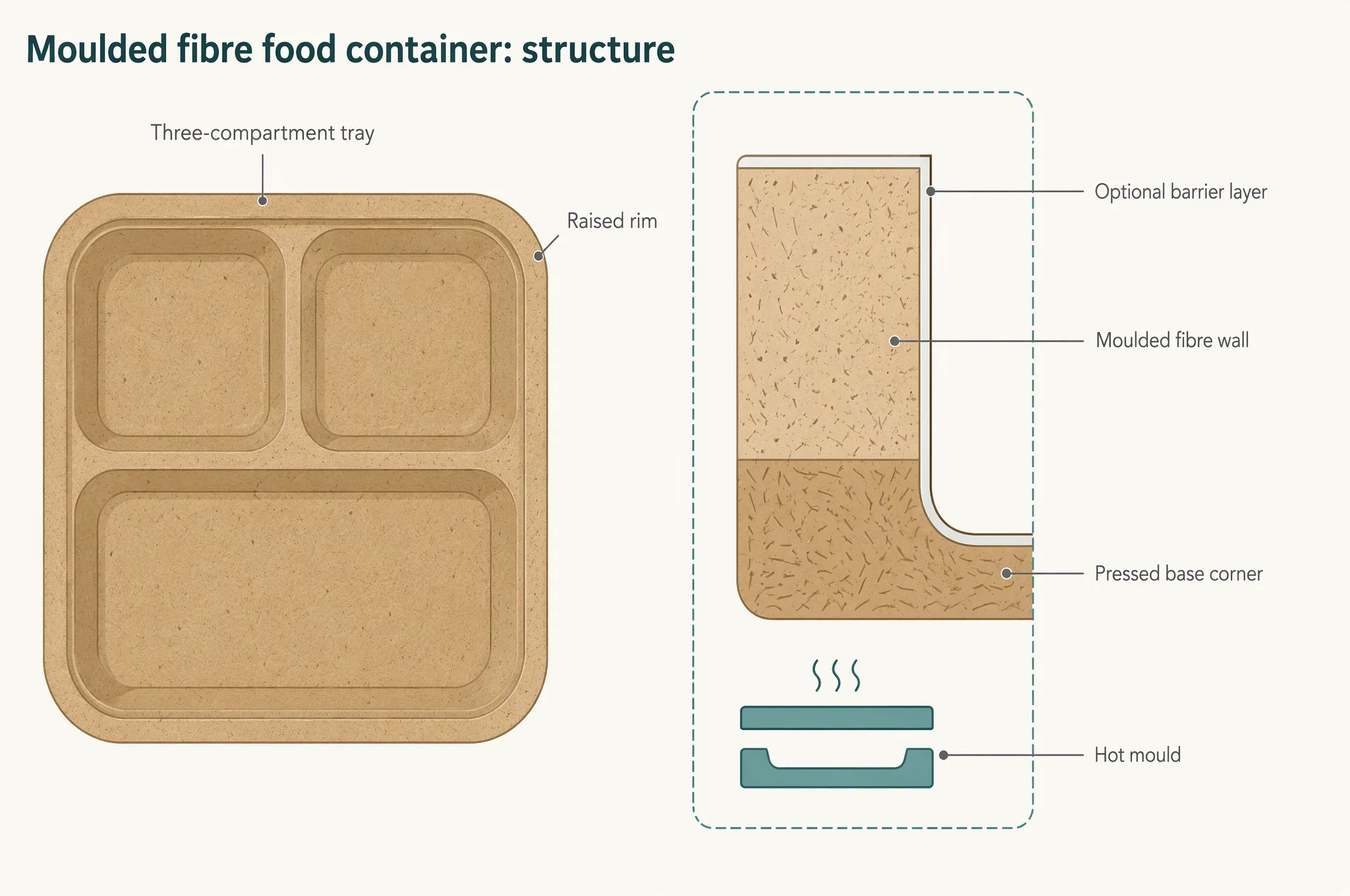
Wall thickness at the base corner carries the load, and an average figure hides the weak point. Ask for the minimum, not the mean.
Working volume, not brimful volume, decides whether the sauce arrives in the bag or in the tray.
Stack height decides your freight and your packing bench. Nested containers with an inconsistent taper build a tall, unstable stack, and a tall stack crushes at the carton corner.
Our figures for all three are [to be confirmed] until the factory data sheet is signed off.
Grease Is the Real Test
Water resistance is not grease resistance. Uncoated moulded fibre holds a wet salad for a service period. A hot, oily curry will mark the wall within minutes and wick through over a longer sitting. Suppliers answer this with a barrier: a dispersion coating, a laminated film, or a fluorochemical treatment.
Ask which chemistry sits on the food-contact side, and get the answer in writing. Fluorochemical grease barriers are under regulatory pressure in several markets, and "grease resistant" on a drawing tells you nothing about the food, the temperature or the contact time. A useful report names the food simulant, the temperature and the duration. We can supply barrier options and the matching test data for the exact construction you order: [to be confirmed].
Compostability Has to Come With a Certificate
Compostability is certified per product, not per material, and the words are not interchangeable with "biodegradable" or "made from plants". EN 13432 is the usual industrial-compostability reference in Europe and ASTM D6400 in the United States; home compostability is a separate claim with separate evidence.
Ask for the certificate number, the certificate holder and the expiry date, then check that the product type on the certificate matches the container you are buying. Paperwork does not travel between products - a compostability certificate issued for a straw tells you nothing about a tray. For the bagasse food containers in this article, we do not yet hold such a certificate: [to be confirmed].
Compliance, Stated Plainly
Under Directive (EU) 2019/904, bio-based and biodegradable plastics are managed as plastics, and single-use plastic straws are listed in Annex Part B. A moulded fibre container is not a plastic product in itself, but a barrier layer or a laminated film changes the analysis. Which obligations attach to a finished pack depends on the construction, the market and the way the pack is used, and that final classification is the buyer's call rather than ours.
Six Checks Before You Order
1. Moulded fibre or coated paper-board tray, decided before price.
2. Minimum wall thickness at the base corner, in millimetres.
3. Working volume against the portion you actually serve.
4. Barrier chemistry on the food-contact side, named in writing.
5. Compostability or migration report with number, holder and expiry.
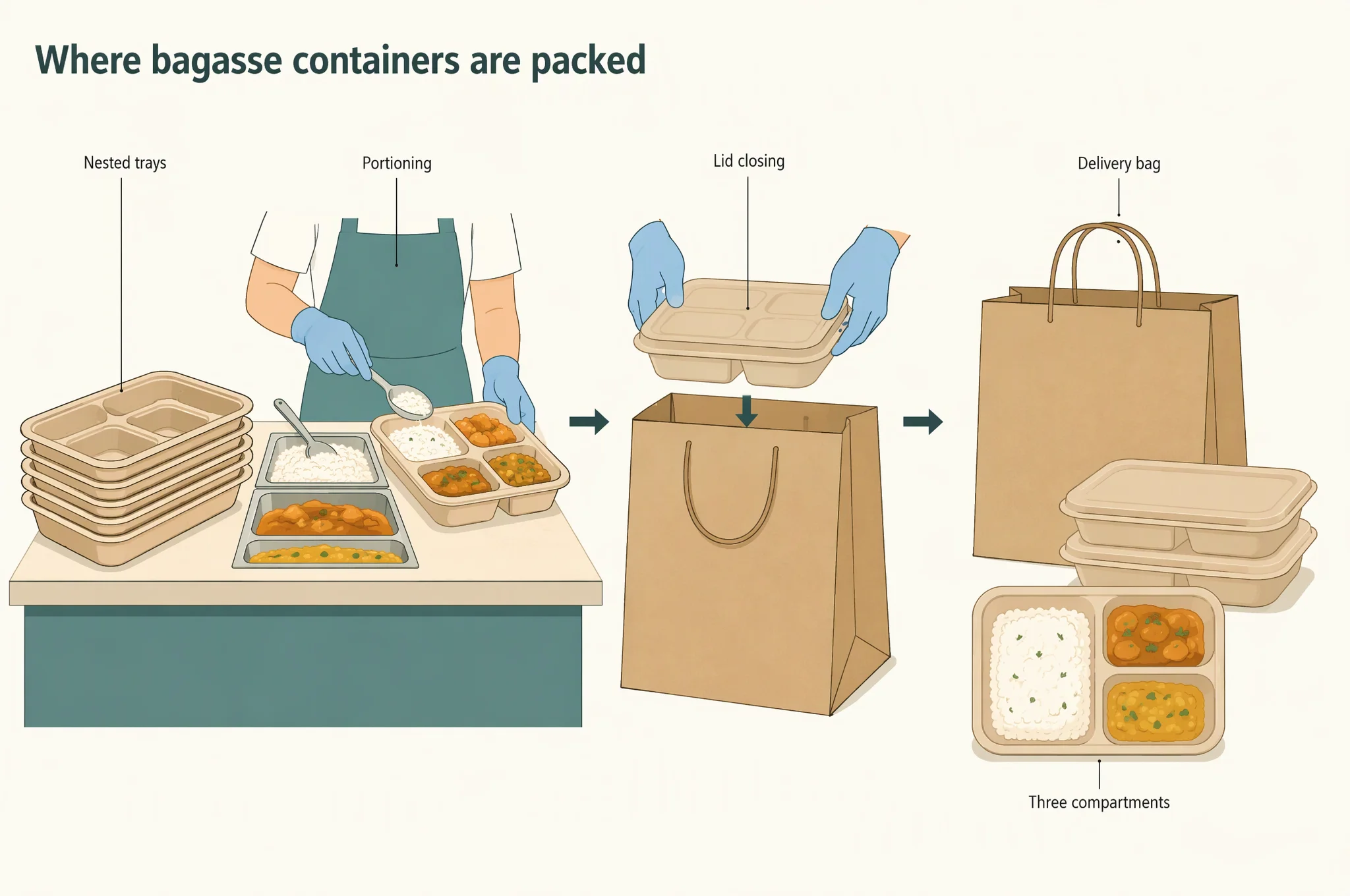
6. Packing: nested quantity per sleeve, pieces per carton, carton size and gross weight - [to be confirmed].
Send us the dish, the portion in grams, whether it is hot and oily, how far it travels and the market you sell into. We will tell you which bagasse food container survives that journey, and which documents we can actually put in your hand.